

Trade liberalization and new demand requirements have dramatically transformed the Canadian textile industry. In fact, many companies have successfully undertaken a strategic shift from traditional textiles to high value-added textiles.
Towards
value-added textiles

Brief overview of
the Canadian textile sector
The Canadian textile industry, which includes NAICS codes 313, 314, and 325220, remains an important manufacturing sector composed largely of SMEs. The most recent public data shows that sub-sectors 313 and 314 comprised 1,615 establishments in 2025 and generated, in 2023, nearly $3.7 billion in manufacturing shipments and over $1.7 billion in value added.
Source: ised-isde.canada

1615
Number of Establishment
(2025)
(2025)
(NAICS Codes 313 and 314)

3.7
B
Manufacturing Shipments
(2023)
(2023)
(NAICS Codes 313 and 314)

1.6
B
Exports
(2024)
(2024)
(NAICS Codes 313 and 314)

751
M
Total Wages
(2023)
(2023)
(NAICS Codes 313 and 314)
Innovative
Product Offering
Canadian companies are increasingly distinguishing themselves across a range of market niches and sought-after technical applications.
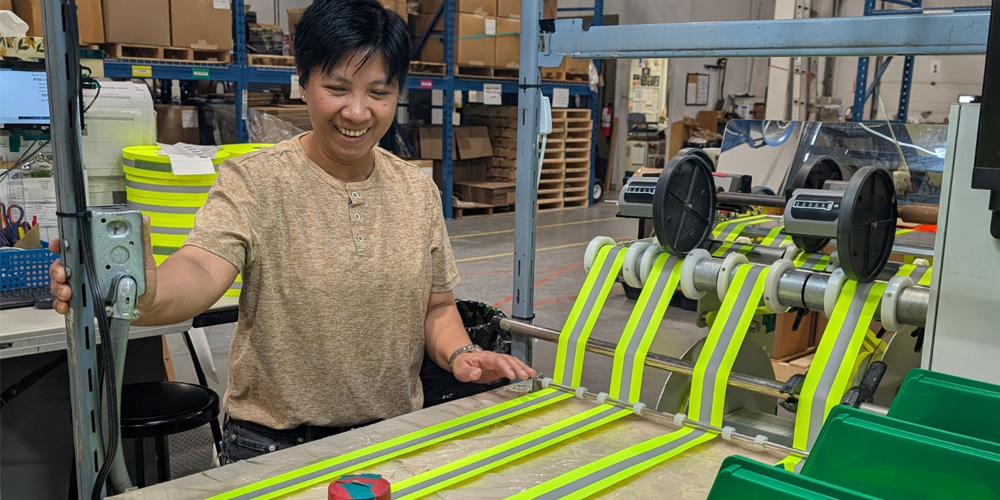
High value-added technical textiles are also widely used by many companies as necessary inputs in the manufacturing of finished goods. As such, they form part of the value chain of several Canadian and international industrial sectors.
On the technology front, smart textiles have seen growing adoption since 2010, particularly in the fields of medical apparel and sportswear.

PROTECTION
SAFETY

SPORTS & OUTDOORS

DEFENSE

MEDICAL

HEALTH

TRANSPORTATION & MOBILITY

AGRICULTURE

INFRASTRUCTURE & CONSTRUCTION

SUSTAINABLE DEVELOPMENT

AEROSPACE
Success
Factors
The diversification of export markets, based on the various free trade agreements concluded by Canada, is part of the business strategies of Canadian textile companies.
To remain competitive in the face of foreign competition, Canadian companies are increasingly focusing on:

The development of innovative, distinctive, and high-performance products

The acquisition of new skills and competencies